Is a “Facebook Evaluator” Job Actually Legit?
The short answer is: it depends entirely on where you heard about it. There are real, paying Facebook evaluator jobs, and there are convincing scams wearing the same name. Here is how to tell them apart.
First, What Is a Facebook Evaluator?
A “Facebook evaluator” — more commonly called a social media evaluator — is a real job category in the AI data industry. Workers log on to Facebook or Instagram, review ads and content, and rate them for relevance, quality, and policy compliance. This feedback is used to improve Meta’s machine-learning systems for ad targeting and content ranking.
These roles are not hired directly by Meta or Facebook. Instead, Meta outsources this work to specialist data-collection companies that recruit independent contractors globally. That distinction matters enormously, because scammers exploit the vagueness around it.
Important: Facebook/Meta does not directly hire “evaluators” through social media posts, DMs, or third-party job ads you stumble across. If someone contacts you out of the blue about a Facebook evaluator role, treat it with suspicion until verified.
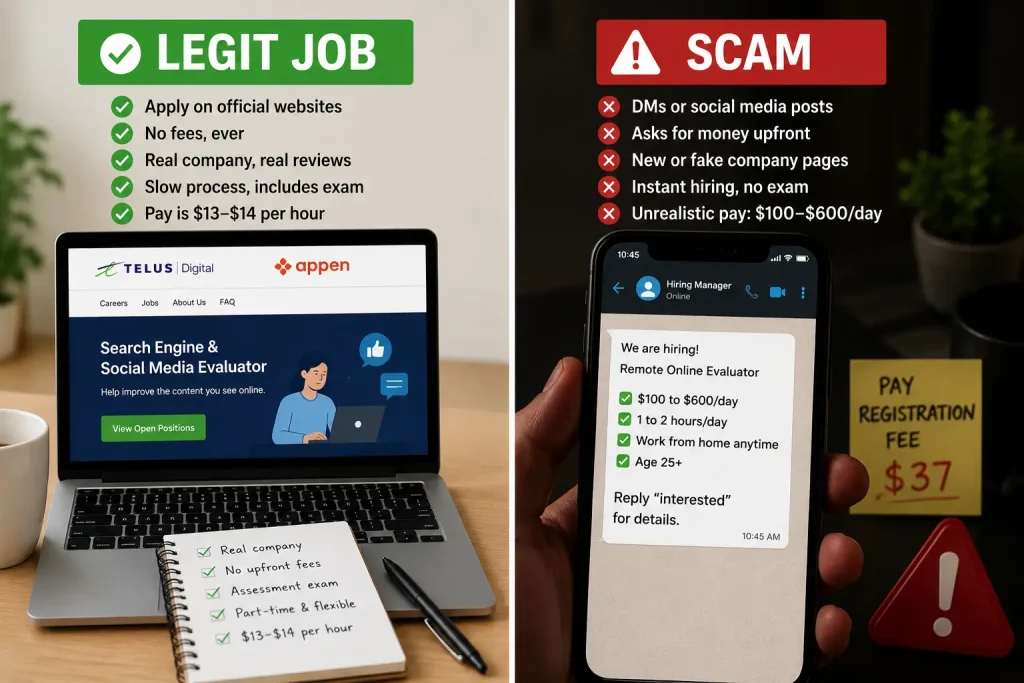
The Legitimate Version: Real Social Media Evaluator Jobs
The genuine version of this role does exist and is widely documented. Two companies are the main employers:
- TELUS Digital (formerly Lionbridge AI) — pays roughly $13 to $14/hr. Rated 3.5/5 on Glassdoor. Part-time, flexible hours. Apply at telusinternational.com.
- Appen — pays roughly $13 to $14/hr. Apply as “Internet Analyst.” Facebook projects include “Project Nile.” Rated 3.7/5 on Glassdoor. Apply at appen.com.
- Welocalize / RWS — pay varies. Also hires for social media and search evaluation tasks, though openings are fewer.
These positions are part-time, independent contractor roles, typically one to four hours a day, up to 20 hours per week. They are flexible but not especially well-paid, and work can be irregular. Think side income, not a primary career.
“My responsibility was to rate ads on Facebook and determine if they were appropriate for the platform. The job took less than an hour a day and paid nearly $10. There is consistent work and steady pay.” — Verified Glassdoor review, TELUS Digital Social Media Evaluator
The application process is also deliberately slow. It can take weeks or months, and you must pass an online assessment exam that is reportedly challenging. This is completely normal for legitimate evaluator roles, and it is itself a distinguishing feature from scams, which onboard you instantly.
The Scam Version: “Facebook Evaluator” Job Ads
A fraudulent version of this role has spread across Facebook through posts in job groups, direct messages, and even paid advertisements. These scams use the legitimacy of the real evaluator industry as cover.
Scam messages typically read something like: “We are hiring! Remote Online Evaluator. $100 to $600/day. 1 to 2 hours/day. Work from home anytime. Age 25+. Reply ‘interested’ for details.” This template has been flagged by Malwarebytes and reported widely across the US.
Here are the red flags to watch for:
- They ask for an upfront fee. People report paying $5, $37, and more to “register” or receive “training materials.” Real evaluator companies never charge you to work for them.
- The pay is wildly unrealistic. $100 to $600 per day for one to two hours of easy work does not exist in this industry. Real evaluators earn roughly $13 to $14 per hour for task-based work.
- You are recruited via DM or a social media post. Legitimate evaluator companies do not cold-contact you on Facebook. You apply to them through their official websites.
- You are pushed to a third-party messaging app. Scammers frequently move conversations to WhatsApp, Signal, or proprietary apps to avoid scrutiny and collect more personal data.
- The company page is brand new. A Facebook page with few followers and no posting history is a classic indicator of a fraudulent operation.
- You are hired instantly, no test required. Real evaluator jobs require you to pass an exam. Scam “jobs” onboard you within minutes, because there is no real job.
- They ask for personal or banking details upfront. Requests for your Social Security number, bank account, or ID before any formal hiring process are serious warning signs of identity theft.
How These Scams Typically Play Out
The most common scenario is an advance fee scam. After you show interest, you are told to pay a small fee for a starter kit, training access, or equipment deposit. Once you pay, either nothing happens, or you are asked for progressively larger amounts before the recruiter disappears entirely.
A second common scenario involves data harvesting. The “job” does not ask for money up front, but collects your email, phone number, bank details, and ID under the pretence of onboarding. This information is then sold to other fraudsters or used for phishing and spam.
In some sophisticated cases, scammers impersonate real companies, including Qualys, NPAworldwide, and even Meta itself, using stolen logos, fake offer letters with correct addresses, and cloned websites.
How to Tell the Difference at a Glance
A legitimate social media evaluator role will have these characteristics:
- You found it by applying to TELUS Digital or Appen directly through their official websites, not through your Facebook inbox.
- The company has a verifiable, multi-year online presence. Search the company name plus “Glassdoor” or “reviews.” Both TELUS Digital and Appen have thousands of verified reviews.
- No money is ever requested. This is the single most reliable rule: a legitimate employer never asks you to pay them.
- The hiring process is slow and includes a real exam. Real applications can take weeks or months to process. Instant onboarding is a scam indicator.
- Pay expectations are realistic. Roughly $13 to $14 per hour for task-based, part-time work, not $300 per day for 90 minutes of effort.
What to Do If You’ve Already Been Caught Out
- Stop all contact immediately. Do not send any more money, regardless of what the “recruiter” tells you.
- Contact your bank if you made a payment and report it as fraud. Many banks can reverse recent transactions.
- Change passwords on any accounts that share credentials with the email address you used.
- Monitor for phishing. Your email and phone number may have been sold. Be suspicious of unexpected calls or emails asking for further information.
- File a report with the FTC at reportfraud.ftc.gov (US), Action Fraud (UK), or your national consumer protection body.
- Report the Facebook post or profile using the platform’s built-in reporting tools to help protect other people.
The Bottom Line
Social media evaluator jobs are real, but they are modest, part-time roles accessed through established companies, not through viral Facebook posts or unsolicited DMs. If someone on Facebook is offering you easy money to “evaluate” content and wants a fee or your bank details in return, it is a scam.
If you are genuinely interested in this kind of work, go directly to appen.com or telusinternational.com/careers, apply through the official channels, expect a slow process, pass an exam, and earn a modest hourly rate. That version is real. Everything else you see advertised in your feed almost certainly is not.